
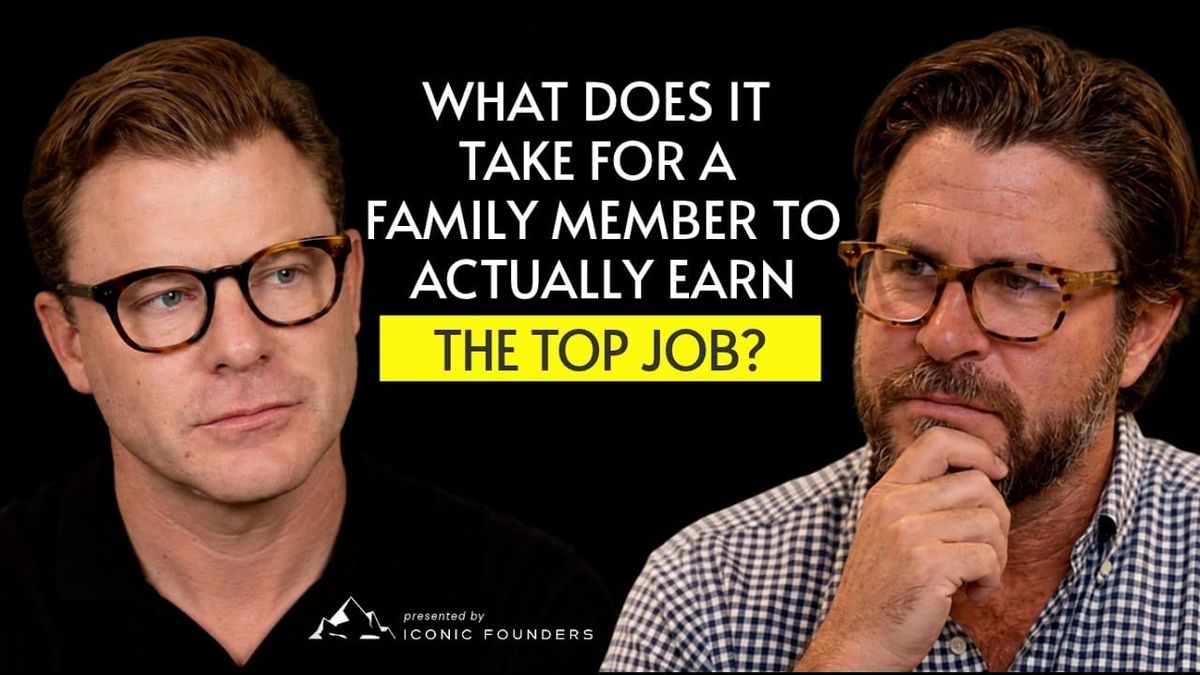
Blood ties don't guarantee business competence. In part two of our conversation, Erik Guggenheim unpacks the messy mechanics of buying out his parents and the six-year estrangement that followed.
Running a generational company requires drawing hard lines between kinship and performance. Erik explains why enforcing a rigid, employee-voted progression track for relatives prevents unearned promotions and toxic work cultures. He shares hard-won methods for transitioning unqualified kin out of executive seats and outlines why forcing a legacy plan often destroys both the enterprise and the household.
For founders wrestling with succession planning, this discussion offers a clear blueprint to separate operational roles from emotional obligations. Subscribe and share this episode with an operator navigating difficult family business dynamics. How do you maintain objective performance standards when your employees share your last name?
Running a blue-collar business? Wondering how to think about value or selling? Iconic Founders Group helps founders like you explore what's next. If you're doing over $2M in profit, check us out at iconicfounders.com or send us a message at theturn@iconicfounders.com.
Iconic Links:
• Learn More: www.iconicfounders.com
• Connect: theturn@iconicfounders.com
More About this Episode
The Harsh Reality of Family Business
In my conversations with founders who have built incredible businesses, created massive value, and navigated the complex waters of life during and after an enterprise sale, a recurring theme constantly surfaces. The concept of a family business is often heavily romanticized in our culture. We picture generations working shoulder to shoulder, seamlessly passing down a legacy of hard work, shared values, and financial success. However, the ground reality of family business dynamics is frequently much more complicated, heavily nuanced, and sometimes, incredibly painful. Running a company with the people you are related to introduces a unique set of challenges that can test the bonds of kinship to their absolute limits. It is a topic that requires deep honesty, especially for founders who are actively looking toward succession planning and the eventual transition of their hard earned enterprise.
When we look closely at the intersection of family and commerce, we must acknowledge a difficult truth that many founders struggle to accept. Family is not always the best option for the future of a business. This statement might sound controversial to an entrepreneur who has spent decades building a company with the explicit dream of handing it over to their children. Yet, it is a crucial realization for both the long term health of the business and the fundamental preservation of the family itself.
The Founder's Dilemma: Pride, Control, and Letting Go
One of the most profound struggles in family business succession planning revolves around pride, unrealistic expectations, and the inability of the founding generation to let go. Many founders build their companies from the ground up, pouring their blood, sweat, and tears into every operational detail. Over time, the business inherently becomes their primary identity. When the time finally comes to step back and let the next generation take the reins, a deep sense of jealousy or a crippling loss of control can set in. A founder might hand over the title of president or executive vice president to their child, head to the golf course, and then obsessively monitor the company financials from a distance. If the company dips into the red, they panic. If it surges into the black and the child proves highly capable, they still panic because they feel they have lost control of their own creation.
This specific dynamic often leads to severe friction and family business conflicts. A child might take the foundational vision of the parent and scale it to new heights, surpassing the original goals set decades prior. Instead of overflowing with pride, the parent might feel overshadowed or replaced. They provided the foundational tools, the education, and the opportunity, but when the child outdoes them, quiet resentment brews. This toxic cycle can lead to total breakdowns in communication. There are cases where parents and children in business together stop speaking for years, culminating in forced buyouts, legal battles, and shattered relationships. The painful irony is that the child is usually just trying to execute the vision to make the parent proud, while the parent feels their lifelong legacy is being overwritten by the very person they trained.
It often takes a massive wake up call, sometimes a terminal health diagnosis or a major life event, for these estranged family members to finally reconcile. When the end of life approaches, the business metrics and the balance sheets suddenly matter very little. The realization dawns that years were wasted arguing over operations, equity, and corporate control when the only thing that truly mattered was the personal relationship. The tragedy is that founders could avoid this entirely if they learned to disconnect their self worth from the organizational chart. Allowing themselves to pursue new passions, perhaps in academia, consulting, or completely unrelated hobbies, helps them let go of the strings holding them to the daily operations.
Earning the Seat: Structuring Paths for Succession and Exit
Another critical rule of navigating family business dynamics is recognizing that not everyone in the family is cut out to run a company. Just because you have a child in the business does not mean they are the best fit for the role of Chief Financial Officer or Chief Executive Officer. Sometimes, a son or daughter might be the most talented equipment operator, the best welder, or the most effective field manager on the crew, but they have zero desire to manage corporate strategy or handle high level executive stress. Pushing them into an executive role is a recipe for disaster. It forces a square peg into a round hole and sets them up for inevitable failure.
When an enterprise reaches a certain phase of maturation, leadership must look at the entire market of available talent. The company needs the absolute best, most qualified person at the helm to navigate critical transition phases, whether that involves scaling operations, taking on private equity, or preparing for a complete exit. Too many families fail to pit their own family members against highly qualified third party candidates. The standard should always be that the best person wins the job, regardless of their last name. If that person is not a family member, the family must accept that reality for the good of the entity they have built and the employees who rely on it.
Furthermore, businesses must be structurally designed to allow family members to gracefully exit if they realize the industry is not for them. People change, and their professional interests evolve naturally over time. A child who joins the company in their early twenties might realize a decade later that they would much rather be ranching, teaching, or pursuing architecture. Forcing them to stay out of a misplaced sense of duty to a family legacy only breeds deep seated resentment. Utilizing personality testing and holding regular, honest career evaluations can help pinpoint whether family employees are truly fulfilled. If they are not, founders must actively help them find their true path, even if it leads far away from the corporate headquarters.
For those family members who do choose to stay and aspire to leadership, the path must be earned with immense effort, never simply given. A successful family business must establish a clear, documented scale of progression. Every employee, from the newest hire to the seasoned veteran, should have a clear roadmap showing exactly what it takes to become the CEO. This transforms a mere job into a lifelong career path, building a strong corporate culture and drastically reducing turnover.
When it comes to family members climbing this corporate ladder, the standards must be exceptionally high. A reliable philosophy is that a family member should have to work twice as hard, face far more scrutiny, and earn significantly less in their early years than anyone else. They must become absolute experts in every department they touch. In some highly functional organizations, the promotion of a family member into leadership must be unanimously supported by the non family employees they manage. This ensures that respect is earned through sweat, competence, and leadership ability, not through bloodlines. The reality is that the lowest ranking employee on the crew dictates the true strength of the company, and leaders must deeply understand the business from the ground up to effectively manage it.
Preserving the Family Bond Beyond the Corporate Legacy
Building a company that operates independently of the founder is a critical step in this entire succession process. This is where implementing a robust value creation program becomes absolutely essential. Many blue collar founders spend years scaling their operations, acquiring smaller competitors, and putting rigorous systems in place. However, they often reach a plateau where they need an outside perspective to take the final leap toward an exit or a major transition. Bringing in a board of advisors, consisting of individuals who have already walked the path of growing, scaling, and selling a business, can be transformative. These seasoned coaches help founders look at their operations objectively. They force the difficult conversations about whether the current leadership team, including the family members, is truly capable of handling the next stage of aggressive growth. By focusing strictly on value creation, founders make their businesses more attractive to buyers and far more resilient to internal family conflicts. It shifts the focus from emotional family ties to objective business performance.
The ultimate goal of succession, if it is to happen within the family structure, should be to reach a point where the founder has absolutely nothing left to teach the successor. When a parent can look at their child, who has worked their way up from the very bottom of the organization, and honestly say that the child has completely mastered the industry, a profound shift occurs. The professional wedge between parent and child is finally removed. The dynamic reverts from boss and employee back to parent and child. At this stage, the successor will undoubtedly still face challenges, but those challenges will likely be personal or emotional, not operational. They will seek their parent's advice not on how to run a balance sheet, but on how to navigate the complex phases of life. This is the true hallmark of a successful transition.
Ultimately, the most important lesson in running a family enterprise is understanding that the business must never supersede the family relationship. Many highly successful founders have seen their personal homes fall apart because they allowed the stress of the boardroom to constantly infect their dinner tables. It is incredibly easy to justify working constantly by claiming you are providing for your children's future. You might think that funding a luxurious vacation justifies being glued to your phone for the entire trip.
However, children do not measure your love by the prestige of the hotel or the eventual size of the inheritance. They measure it by your presence and your attention. A child would much rather stay at a budget motel if it means their parent is actually in the swimming pool with them, completely disconnected from work. When you leave the office, you must learn to shut the door completely. No customer, balance sheet, or operational crisis is more important than being fully present for a simple conversation with your family.
Building a company is a phenomenal human achievement. It provides vital jobs, solves critical problems in the market, and drives our economy forward. But the legacy you leave behind will not be found in an organizational chart, a stock portfolio, or a corporate bank account. It will be found in the character of your children and the strength of the bonds you share with them. By keeping the family aspect of the family business in its rightful, prioritized place, we can build truly iconic companies without sacrificing the very people we set out to provide for in the first place.

Member discussion: